


From 1990’s Client-Server to Today’s AI Code-Generated Applications
Are we repeating the same enterprise mistake from the 1990s client-server era — only at 100x scale with AI code generation?
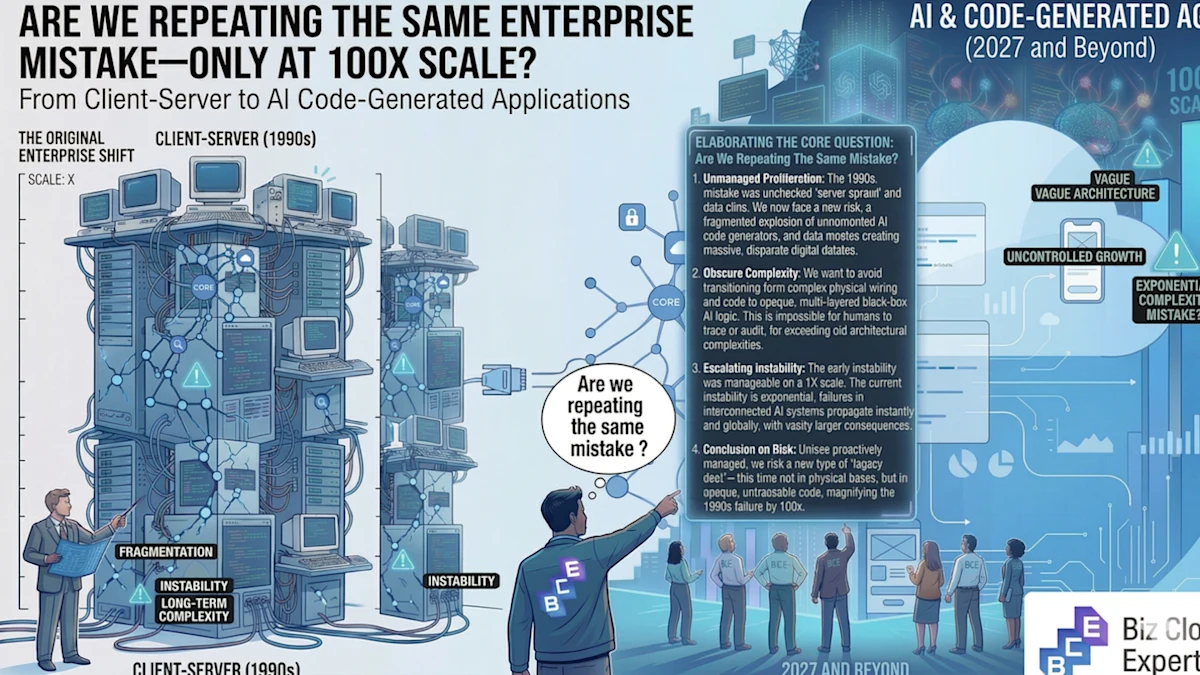
Are We Repeating the Same Enterprise Mistake—Only at 100x Scale?
In the early 1990s, enterprises went through a fundamental shift in how software was built and deployed. The move from centralized mainframes to distributed client-server systems unlocked unprecedented speed and flexibility—but also introduced fragmentation, instability, and long-term complexity.
This transformation was not driven by a single innovation. It was the convergence of three forces:
Cheap hardware + newer (less mature) operating systems + powerful but simplified developer tools
Together, they changed who could build software, how fast it could be built—and where control resided.
Today, AI code generation is recreating this exact dynamic—only faster, broader, and potentially far more disruptive.
1. The Pre-90s World: Discipline Was Built Into the System
Before the client-server era, enterprise systems were built on:
TPF (Transaction Processing Facility)
COBOL-based mainframe systems
C/C++ on UNIX platforms
These environments were not easy—and that was precisely the point.
What defined this era:
🔹 High Complexity
Required specialized engineers
Deep system-level expertise
Long development cycles
🔹 Strong Architectural Discipline
Clear separation of concerns
Structured transaction processing
Strict engineering practices
🔹 Centralized Governance
Systems built and deployed in controlled environments
Managed by enterprise IT
Changes tightly governed
🔹 Extreme Reliability
Powered airlines, banking, telecom
Designed for high-volume, mission-critical workload
The Pre 90's summary
Systems were hard to build—but once deployed, they were stable, predictable, and long-lasting.
Many of these systems continue to run today—not because they are modern, but because they were built with discipline.
2. The Perfect Storm of the 1990s
The 1990s didn’t just introduce new tools—it removed constraints that had previously enforced discipline.
2.1 Cheap Hardware
PCs and commodity servers became affordable
Infrastructure no longer required enterprise-level investment
Compute power moved into departments
👉 Control began shifting away from centralized IT.
2.2 Newer, Less Mature Operating Systems
Platforms like Windows NT (1993) enabled distributed computing
But:
Lacked operational maturity initially
Had evolving security models
Were not as stable as mainframes
👉 Easier to deploy—but easier to break.
2.3 Powerful Developer Tools
This was the true inflection point.
Tools like:
Visual Basic
PowerBuilder
enabled:
Drag-and-drop development
Event-driven programming
Direct database connectivity
Compared to traditional TPF, COBOL, or C/C++ on Mainframe & Large Unix Systems, RAD Tools offered simple, fast, accessible & decentralized development to Enterprise Managers
2.4 Speed and Cost: The Hidden Accelerators
This shift wasn’t just technological—it was economic.
From Months to Weeks
Traditional systems took months or years to build
RAD tools enabled delivery in weeks—or even days for PoCs
Collapse of CAPEX Barriers
Before:
Expensive hardware procurement
Long approval cycles
Enterprise-level justification
After:
Applications built on low-cost hardware
Funded within line-of-business budgets
No centralized approval needed
The Outcome from Early 1990's
Systems could now be built faster and cheaper than ever before—without the controls that previously governed them.
3. The Reality: From Explosion to Stabilization
When these forces came together, enterprises didn’t just gain agility—they lost control.
Application Explosion
Hundreds of applications across departments
Systems built in weeks instead of months
No central inventory or ownership
“Cube Servers” and Shadow IT
Applications were deployed on:
Desktop machines
Under-desk servers
Unmanaged environments
These systems were:
Not monitored
Not secured
Not backed up
Fragile Architectures
Tight coupling between UI, logic, and database
Limited fault isolation
High sensitivity to failure
Lack of Lifecycle Discipline
Most applications lacked:
Version control
Testing practices
Documentation
Security design
Key-Person Dependency
One developer builds a system
That developer leaves
The system becomes:
Hard to understand
Risky to modify
Operationally fragile
The Tradeoff & The Correction
What emerged was a fundamental shift:
We reduced the complexity of building systems—but increased the complexity of managing them.
TPF / COBOL / UNIX → hard to build, stable to run
VB / PowerBuilder → easy to build, hard to evolve
Enterprises didn’t fix this overnight. It took 10–15 years to regain control by:
Moving systems into centralized data centers
Standardizing infrastructure
Introducing monitoring and observability
Adopting structured service management practices (e.g., ITIL)
Establishing enterprise architecture governance
Stability had to be rebuilt after the fact.
4. Are We Seeing the Same Pattern Again?
History is often the best indicator of the future.
So the question is:
Is AI code generation repeating the same dynamics we saw in the client-server era?
Are the Underlying Forces Similar?
1990sTodayCheap hardwareCloud (on-demand compute)Immature OSRapidly evolving AI ecosystemsVB / PowerBuilderAI code generation
Once again:
The barrier to building systems has collapsed
The speed of development has accelerated
Control is shifting away from centralized governance
Is Software Becoming Easier to Create Than to Manage?
AI enables:
Instant code generation
Applications built in hours or days
Participation from non-developers
But it also raises critical questions:
Are we creating more systems than we can track?
Do developers fully understand what they are generating?
Are hidden dependencies growing faster than we can manage?
Does maintenance become the real bottleneck?
Are We Repeating the Same Tradeoff?
Are we once again reducing the complexity of building systems—only to increase the complexity of managing them?
In the 1990s:
Systems moved from months → weeks
Today:
Systems are moving from weeks → hours
Is This Time Different—or Just Faster?
The scale is different. The speed is different. But the pattern feels familiar.
When the cost of creation drops faster than the ability to manage systems, complexity debt explodes.
5. Why This Could Be 100x Worse
Volume
AI removes the natural constraint of human effort → Exponential growth in software. A Developer can leveragi
Speed
What moved from months → weeks in the 90s is now moving from weeks → hours
Loss of Intent
Systems may:
Lack clear design
Lack documentation
Lack ownership
Weak Lifecycle Thinking
AI code generation excels at creating solutions—but without strong design and discipline, those systems will struggle to be maintained, governed, and evolved over time.
The Core Insight
When the cost of creation drops faster than the ability to manage systems, complexity debt explodes.
This happened in the 1990s.
It is happening again now—at a much larger scale.
The lesson from the client-server era is not that democratization is bad—it’s that governance must evolve alongside it.
TPF, COBOL, and UNIX systems enforced discipline because they were hard.
Visual Basic and PowerBuilder removed friction—but also removed guardrails.
AI is now removing friction almost entirely.
The future will not be defined by how fast we can generate software— but by how well we can understand, govern, and evolve what we’ve already built.
5. The Path forward
When the cost of creation drops faster than the ability to manage systems, complexity debt explodes.
This happened in the 1990s. It is happening again now—at a much larger scale.
The lesson from the client-server era is not that democratization is bad—it’s that governance must evolve alongside it.
TPF, COBOL, and UNIX systems enforced discipline because they were hard.
Visual Basic and PowerBuilder removed friction—but also removed guardrails.
AI is now removing friction almost entirely.
This is not a reason to slow down innovation—it is a call to lead it responsibly.
Organizations that succeed in this era will not be the ones that generate the most code—
but the ones that:
Establish governance early
Enforce architectural discipline
Build for maintainability and evolution
Treat AI as a force multiplier—not a shortcut
At BizCloud Experts, we don’t see this as a new problem—we recognize it as a familiar pattern, now unfolding at unprecedented scale.
We are led by practitioners who have lived through the client-server transition, experienced its challenges firsthand, and understand the cost of unchecked system proliferation.
That experience shapes how we approach the future. We are at the forefront of helping organizations adopt:
Responsible AI practices
Sustainable architecture principles
Governed, enterprise-grade AI solutions
Because the goal is not just to build faster— but to build systems that:
Can be understood
Can be trusted
Can evolve
Can sustain the test og time
The next era of technology will not be defined by how quickly we can create systems—but by how responsibly we can sustain them.
References:
These references highlight the evolution from distributed, heterogeneous server environments in the 1990s to the need for centralized data centers, operational discipline, and structured IT service management practices.
IBM – Mainframe Architecture: Secure, Compatible, Still Evolving
Microsoft – 30 Years of Windows Server
https://techcommunity.microsoft.com/blog/sbs/30-years-of-windows-server/3884810
Stanford University – Evolution of Data Centers
https://web.stanford.edu/class/archive/cs/cs142/cs142.1196/lectures/Datacenters.pdf
Pearson – Evolution of Data Centers (Sample Chapter)
https://ptgmedia.pearsoncmg.com/images/0130454958/samplechapter/0130454958.pdf
Enconnex – Data Center History and Evolution
IFIP – History of Data Center Development
Wikipedia – PowerBuilder
John Smiley – History of Visual Basic
Free Source Library – PowerBuilder Evolution and Future
https://freesourcelibrary.com/powerbuilder-evolution-and-future/